Targeted Causal Effect Estimation with an Unknown Graph
Estimating causal effects, for example to understand how human activities drive climate change, is fundamental to our scientific understanding and practical decision-making. The gold standard for this is to conduct experiments, but these can be expensive or unethical. For instance, deliberately increasing greenhouse gas emissions to study their effects would be irresponsible. Fortunately, causal effects can also be estimated from observational data, using adjustment variables. These adjustment sets are determined by the causal graph of the underlying process, which can also be estimated by causal discovery methods.

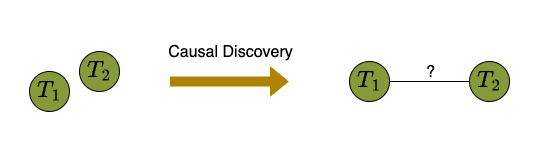
Causal discovery estimates the causal graph, from which valid adjustment sets can be read off for causal effect estimation.
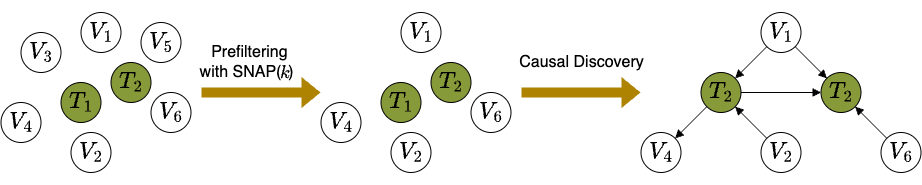
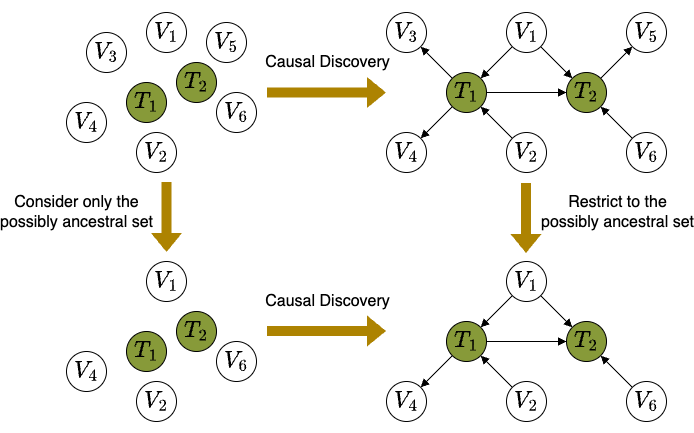
However, discovering the full causal graph can be computationally expensive for large numbers of variables. If we are only interested in the causal effects between a small set of target variables, we may not need to learn the entire causal graph, but just a smaller subgraph that includes the targets and their statistically efficient adjustment sets.

Removing \(V_3\) and \(V_5\) in the previous example decreases the cost of causal discovery, while yielding the same efficient adjustment sets.
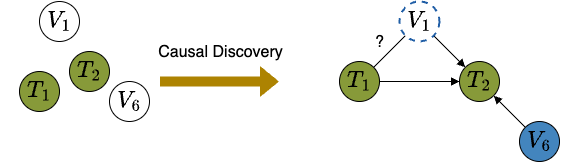
We formalize this problem as targeted causal effect estimation with an unknown graph, which focuses on identifying the causal effects between all pairs of target variables in a computationally and statistically efficient way.
.png)